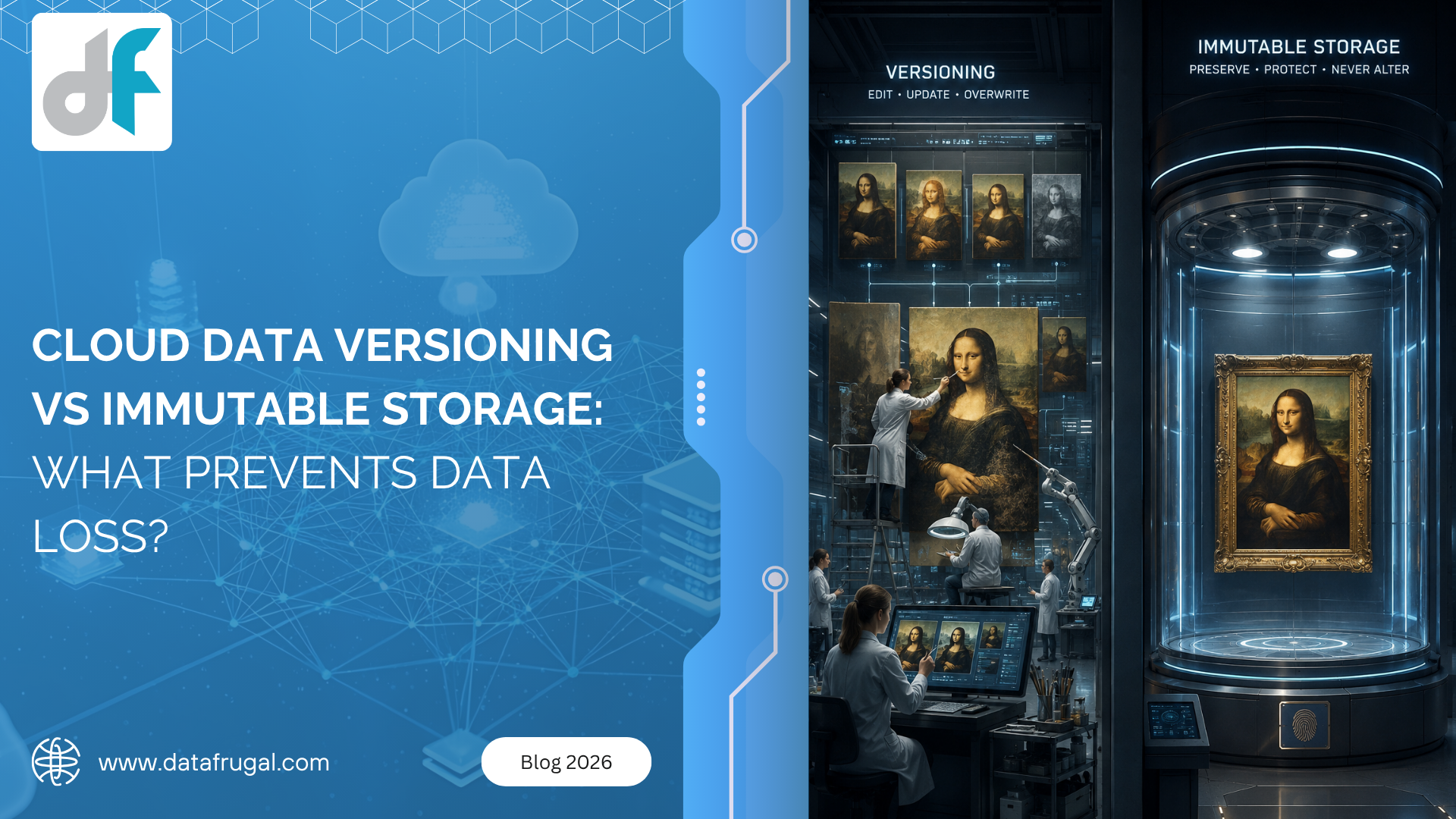
Cloud data protection is no longer just about creating backups. As businesses store more critical data across cloud environments, the focus has shifted toward preventing accidental deletion, ransomware impact, unauthorized modification, and recovery failures.
Two common approaches used to reduce data loss are cloud data versioning and immutable storage. While both improve recovery capabilities, they solve different problems and offer different levels of protection.
Many organizations rely only on versioning and assume their data is secure. In reality, versioning alone is often not enough to fully prevent data loss, especially in large-scale cloud environments.
Understanding how both approaches work together is critical for building a reliable cloud recovery strategy.
What is Cloud Data Versioning?
Cloud data versioning is the process of storing multiple versions of the same file or object over time.
Whenever a file changes, a new version is created instead of replacing the original completely. This allows teams to restore older versions if data is accidentally modified, corrupted, or deleted.
In most environments, file versioning cloud storage is used to:
- Recover accidentally deleted files
- Restore previous file versions
- Track modifications over time
- Support rollback during operational errors
- Improve recovery flexibility for cloud applications
Versioning is commonly used for production data, critical application logs, backup files, repositories, and cloud storage objects.
Why Versioning Helps Reduce Data Loss
Versioning improves operational recovery because it preserves historical copies of files and objects.
Without versioning, accidental overwrites or deletions may permanently remove data.
A structured cloud backup version history helps teams:
- Restore clean versions of files quickly
- Recover from accidental changes
- Maintain historical recovery points
- Reduce downtime during operational incidents
- Improve recovery visibility across environments
For growing cloud environments, version history becomes especially useful when multiple teams access shared systems.
Why Versioning Alone Is Not Enough
While versioning improves recovery, it does not fully protect data from all threats.
Many businesses assume version history guarantees complete protection. However, versioned data can still be modified, deleted, encrypted, or mismanaged if governance controls are weak.
This becomes a major risk during ransomware attacks or misconfigured access control scenarios.
Some common limitations of relying only on versioning include:
- Versioned data may still be deleted by privileged users
- Compromised accounts may modify multiple versions
- Retention policies may not be enforced consistently
- Storage costs increase if versions are unmanaged
- Visibility across environments may remain fragmented
- Recovery points may become difficult to govern at scale
This is where immutable storage becomes important.
What is Immutable Storage?
Immutable storage prevents stored data from being modified or deleted for a defined retention period.
Once data is written, it becomes locked and protected from changes, even by administrators or compromised systems.
Immutable storage is commonly used for:
- Ransomware-safe backups
- Compliance-driven backup retention
- Long-term storage of critical production data
- Audit logs and access records
- Disaster recovery environments
Unlike versioning, immutable storage focuses on preserving data integrity instead of simply maintaining historical copies.
How Immutable Storage Prevents Data Loss
Immutability improves operational trust because critical recovery data remains protected even during ransomware incidents, privileged account compromise, or accidental administrative actions.
Because stored data cannot be altered during the retention period, businesses gain more reliable recovery assurance.
Key benefits include:
- Protection against ransomware encryption or deletion
- Prevention of unauthorized modification
- Reliable retention for critical backups
- Improved audit and compliance visibility
- Safer disaster recovery environments
- Reduced risk from insider threats or compromised credentials
For businesses managing production backups and critical audit logs, immutability provides an additional layer of operational trust.
Why Businesses Need Both Versioning and Immutability
Versioning and immutable storage are not competing solutions. They solve different recovery problems.
Versioning helps teams recover operationally from accidental changes, while immutable storage protects recovery data itself from compromise.
A stronger cloud recovery strategy combines both approaches.
For example:
- Versioning helps restore previous file states during operational errors
- Immutable storage protects backup copies from deletion or ransomware attacks
- Version history improves flexibility
- Immutability improves integrity and recovery assurance
Modern cloud environments increasingly require both capabilities to reduce recovery risk effectively.
Managing Version History and Immutable Backups at Scale
As businesses scale across cloud providers and environments, managing recovery policies becomes more operationally complex.
Teams often struggle with:
- Excessive backup versions increasing storage costs
- Inconsistent retention policies across environments
- Difficulty identifying critical recovery data
- Fragmented visibility into backup history
- Complex access control management
- Manual governance processes requiring DevOps effort
This is why businesses increasingly adopt structured governance layers for backup management.
How DataFrugal Supports Structured Cloud Recovery
DataFrugal helps businesses manage versioned backups and immutable recovery storage through a centralized governance layer across cloud environments.
Instead of handling retention, recovery visibility, and storage governance separately across providers, teams can organize and manage critical data consistently.
DataFrugal helps businesses:
- Organize backup data across development, staging, and production environments using labels
- Apply retention policies for critical backups and long-term storage
- Improve visibility into backup versions and recovery environments
- Simplify role-based access control and governance
- Help reduce cloud storage costs by prioritizing critical data retention
- Support structured management across single and multi cloud environments
- Reduce operational complexity without heavy DevOps dependency
This helps organizations build stronger recovery strategies using both cloud data versioning and immutable storage principles.
Summary
Cloud versioning gives point in time behavior for object lifecycle. It helps course correct by providing recovery choices and improving operational tolerance.
Complete dependency on versioning alone is not enough. It still leaves enterprises vulnerable to accidental deletions, gaps in governance, and ransomware attacks.
A system with immutability helps preserve the integrity of stored content during operational mishaps and for audit reporting. What you store is what you get, that generates confidence in the system.
A structured governance approach helps businesses manage backup visibility, retention policies, and recovery control consistently across cloud environments.
FAQs
What is cloud data versioning?
Cloud data versioning stores multiple versions of files or objects so businesses can restore previous versions when needed.
What is file versioning in cloud storage?
It is the process of automatically maintaining historical file copies whenever changes are made.
What is cloud backup version history?
It refers to the stored historical recovery points available for backup data over time.
Why is versioning alone not enough?
Because versioned data can still be deleted, modified, or compromised without proper governance and immutable protection.
What is immutable storage?
Immutable storage is used to preserve audit evidence, release approvals, operational records, critical recovery data, production logs, and compliance-related objects that require long-term retention and protection from modification.
These storage environments prevent data modification or deletion even from administrators, helping businesses maintain operational trust, audit integrity, and reliable recovery assurance during ransomware incidents or governance reviews.