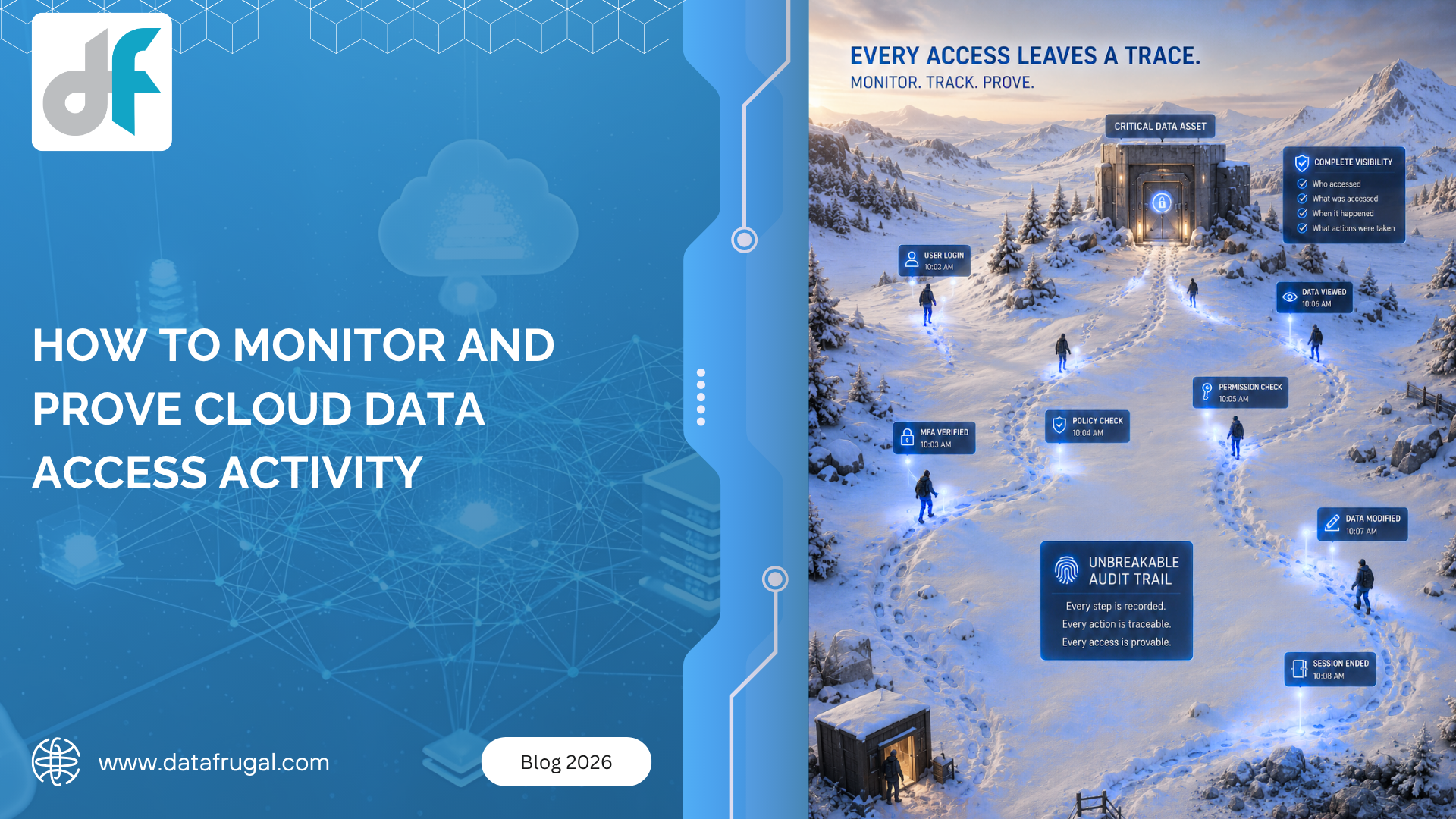
Most organizations assume they can answer a simple question:
Who accessed our data?
The reality is often very different.
During customer audits, security reviews, compliance assessments, or incident investigations, many organizations discover they can see infrastructure activity but cannot easily prove who accessed specific data, what actions were performed, or whether access was authorized.
This creates a major governance challenge.
Enterprise customers, auditors, and investors increasingly expect evidence, not assumptions. They want organizations to demonstrate accountability, operational visibility, and traceability across their cloud environments.
This is why data access governance has become a critical part of modern cloud operations.
Why Proving Data Access Is Becoming a Business Requirement
For many growing organizations, access visibility becomes important only after a trigger event occurs.
Common examples include:
- A customer security questionnaire
- An enterprise onboarding review
- A suspected insider threat
- A public data exposure incident
- An audit or compliance assessment
- An operational investigation
The first questions are almost always the same:
- Who accessed the data?
- When did they access it?
- What actions were performed?
- Was the access authorized?
- Can the activity be verified?
If teams cannot answer these questions quickly, confidence in their governance processes begins to erode.
The challenge is not whether access occurred. The challenge is proving it.
Why Traditional Monitoring Is Often Not Enough
Most cloud platforms provide logs and monitoring capabilities.
However, monitoring infrastructure is very different from proving operational accountability.
Many organizations can identify:
- Server activity
- Network events
- System alerts
- Application performance metrics
But they struggle to demonstrate:
- Who downloaded a specific object
- Who shared sensitive information
- Who modified retention settings
- Who attempted deletion operations
- Whether governance controls were followed
As environments grow across multiple teams and cloud providers, visibility becomes fragmented.
The result is a gap between operational monitoring and governance evidence.
The Growing Importance of Audit Logs
Strong audit logs help organizations create a traceable record of operational activity.
Rather than simply showing that an event occurred, audit records help answer critical governance questions.
Effective audit visibility should provide:
- User identity information
- Time and date of activity
- Object-level actions
- Access history
- Sharing activity
- Policy changes
- Administrative actions
The goal is not just recording events.
The goal is creating evidence that can be used during audits, investigations, customer reviews, and governance assessments.
Why Cloud Environments Create Visibility Challenges
Cloud-native environments are constantly changing.
Teams onboard new users, deploy new services, integrate third-party tools, and increasingly adopt AI-driven automation.
As infrastructure evolves, governance visibility often becomes harder to maintain.
Common challenges include:
- Shared credentials across teams
- Excessive administrative permissions
- Multiple storage environments
- Inconsistent logging practices
- Fragmented visibility across cloud providers
- Limited object-level traceability
These issues often remain unnoticed until an organization is asked to prove what happened during a specific event.
This is where governance visibility becomes more valuable than monitoring alone.
How Data Access Governance Improves Operational Trust
Organizations increasingly need to demonstrate that governance controls are working.
This is especially important when:
- Enterprise customers evaluate vendors
- Investors perform due diligence
- Compliance reviews begin
- Security incidents occur
- Data access questions arise
Strong data access governance helps organizations:
- Improve accountability across teams
- Reduce uncertainty during investigations
- Support customer trust initiatives
- Improve governance reporting
- Strengthen operational traceability
- Provide evidence during reviews and audits
The ability to prove activity often becomes more important than simply detecting it.
Why Enterprise Cloud Security Depends on Visibility
Many organizations focus heavily on prevention.
Firewalls, access controls, permissions, and security policies are all important.
However, modern enterprise cloud security also requires visibility.
Organizations need to prove:
- Who performed actions
- Whether controls were followed
- How operational changes occurred
- What data was accessed
- Whether governance policies were enforced
Without visibility, security becomes difficult to validate.
Without evidence, governance becomes difficult to demonstrate.
This is why operational traceability is becoming a key part of enterprise security programs.
How DataFrugal Helps Organizations Prove Data Access Activity
DataFrugal helps organizations improve governance visibility across storage and cloud environments.
Instead of relying solely on provider-specific logs, teams can establish centralized operational traceability and evidence collection.
DataFrugal helps organizations:
- Monitor object-level access activity
- Improve visibility into uploads, downloads, and sharing operations
- Support audit evidence collection
- Improve governance reporting and accountability
- Maintain immutable operational records
- Support retention and access governance controls
- Simplify investigations and customer reviews
This helps organizations strengthen data access governance while improving operational trust and audit readiness.
Summary
Monitoring cloud activity is important, but proving what happened is becoming equally critical. Organizations increasingly face customer reviews, governance assessments, and security investigations that require evidence rather than assumptions.
By improving visibility into data access activity and maintaining strong audit records, organizations can strengthen accountability, support enterprise security requirements, and build greater trust with customers and stakeholders.
FAQs
Why do organizations struggle to prove data access activity?
Many teams rely on infrastructure monitoring tools that show system activity but lack the operational context needed to demonstrate who accessed specific data and what actions were performed.
What should audit logs capture for governance purposes?
Audit logs should capture user identity, timestamps, object-level actions, sharing activity, policy changes, and administrative operations to support accountability and investigations.
Why is proving access activity important during customer audits?
Enterprise customers increasingly require evidence that organizations can monitor and trace access to sensitive information. Being able to provide this evidence helps accelerate security reviews and build trust.
What is the difference between monitoring and governance visibility?
Monitoring focuses on system health and operational events. Governance visibility focuses on accountability, traceability, and proving what actions occurred across data and storage environments.
How does data access governance support enterprise cloud security?
It helps organizations demonstrate that security controls are working by providing evidence of access activity, operational accountability, and governance enforcement.