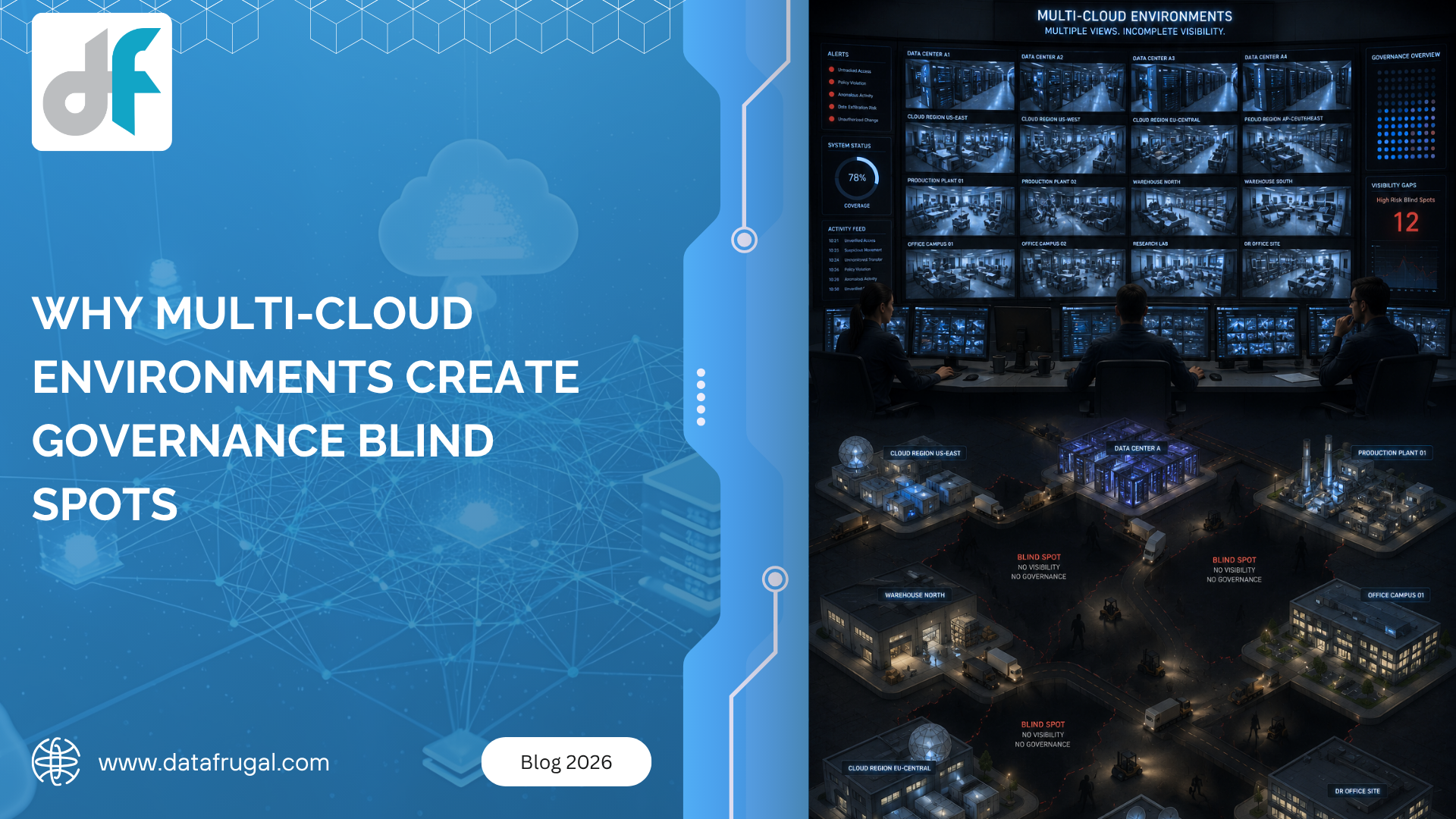
Most organizations move to multi-cloud for good reasons.
A customer prefers a specific cloud provider. A product team adopts a new service. A partner requires integration with a different platform. Over time, infrastructure spreads across AWS, Azure, GCP, private storage environments, and object storage providers.
The problem is that governance rarely scales at the same pace.
What starts as a flexibility advantage often creates operational blind spots that are difficult to detect until an audit, incident, or customer review exposes them.
Many teams assume they have visibility because each cloud provider offers monitoring and logging tools. In reality, governance visibility becomes fragmented as infrastructure expands across multiple environments.
This is why multi cloud governance is becoming a growing priority for cloud-native organizations.
The challenge is not managing infrastructure. It is managing accountability.
Most cloud providers give teams visibility into their own environment.
- AWS shows AWS activity.
- Azure shows Azure activity.
- GCP shows GCP activity.
The problem begins when organizations need answers that span all environments.
Questions such as:
- Who accessed customer data across all cloud platforms?
- Can you prove retention controls are being enforced consistently?
- Which systems were affected during an incident?
- Where is critical operational data stored?
- Can you demonstrate governance controls during a customer audit?
These questions are difficult to answer when governance information is scattered across multiple platforms.
The result is not a storage problem. It is an accountability problem.
How governance blind spots develop over time
Most organizations do not intentionally create governance gaps.
They appear gradually as infrastructure grows.
In many environments:
- New cloud accounts are created for projects
- Teams onboard customers on different cloud providers
- Storage environments expand independently
- Access policies evolve separately
- Operational records become fragmented
Over time, nobody has a complete view of what is happening across the organization.
This creates several common governance risks:
- Inconsistent retention policies across environments
- Different access control models between providers
- Fragmented audit evidence
- Difficulty tracing operational activity
- Limited visibility into customer data access
- Increased risk of configuration mistakes
These risks often remain invisible until governance reviews begin.
Why cloud visibility becomes harder in multi-cloud environments
Many organizations assume cloud visibility simply means monitoring infrastructure performance.
True governance visibility goes much deeper.
Organizations need visibility into:
- Who accessed data
- What actions were performed
- When operational changes occurred
- Whether retention policies were enforced
- Whether data was shared, modified, or deleted
- How governance controls are being applied
Cloud-native logging tools provide pieces of this information, but rarely deliver a unified governance view across providers.
This creates operational friction during investigations, audits, and customer reviews.
Customer audits expose governance gaps quickly
One of the biggest triggers for governance initiatives is customer audit pressure.
Enterprise customers increasingly ask questions such as:
- Can you prove who accessed our data?
- Can you demonstrate retention controls?
- Can you show immutable operational evidence?
- Can you provide audit history across environments?
- How do you monitor governance activity?
Many organizations discover they can answer these questions within individual cloud platforms but struggle to provide a complete picture across their infrastructure.
This creates delays, operational overhead, and reduced customer confidence.
Governance visibility becomes a business requirement, not just a technical requirement.
Why multi-cloud growth increases operational risk
Multi-cloud environments introduce flexibility, but they also increase complexity.
Each provider uses different:
- Terminology
- Access control models
- Storage classes
- Logging structures
- Governance workflows
As teams scale, these differences create operational inconsistencies.
This becomes especially problematic during:
- Security investigations
- Customer audits
- Compliance reviews
- Incident response
- Enterprise onboarding
Without centralized governance visibility, organizations often spend significant time gathering information from multiple systems before they can understand what actually happened.
Why organizations need a governance layer above the cloud providers
Most organizations already have cloud tooling.
The challenge is that cloud-native tools are provider-specific.
They help teams manage infrastructure but often do not provide centralized governance visibility across environments.
This is where a governance layer becomes valuable.
A governance-focused approach helps organizations:
- Improve operational traceability
- Centralize governance visibility
- Support audit evidence collection
- Improve accountability across environments
- Simplify customer security reviews
- Reduce governance complexity as infrastructure grows
The goal is not replacing cloud providers.
The goal is creating consistent governance visibility across them.
How DataFrugal helps reduce governance blind spots
DataFrugal helps organizations improve governance visibility across cloud-native environments without requiring large enterprise governance suites.
Instead of relying solely on provider-specific tooling, teams can establish centralized operational visibility and traceability.
DataFrugal helps organizations:
- Improve audit visibility across storage and object operations
- Support operational traceability across cloud environments
- Collect evidence for governance reviews and customer audits
- Improve visibility into access and operational activity
- Support retention controls for governed data
- Maintain immutable operational records
- Simplify governance reporting across environments
This helps organizations strengthen multi cloud governance while improving operational accountability and customer trust.
Summary
Multi-cloud environments provide flexibility and scalability, but they often create governance blind spots that become visible only during incidents, audits, or customer reviews.
As infrastructure spreads across providers, governance visibility becomes fragmented, making it harder to prove accountability, retention controls, and operational activity.
Organizations that establish centralized governance visibility early are better positioned to support enterprise growth, customer trust, and operational resilience.
FAQs
Why do governance problems often appear after multi-cloud expansion?
Governance usually develops more slowly than infrastructure. As teams add providers, environments, and customers, operational visibility becomes fragmented unless governance controls evolve alongside growth.
What makes multi-cloud investigations difficult?
Information is often distributed across multiple cloud platforms, each with different logging, access control, and reporting mechanisms. This makes it harder to reconstruct events during incidents or audits.
Why do enterprise customers care about governance visibility?
Enterprise customers increasingly require evidence that organizations can monitor access, enforce retention controls, and maintain accountability across cloud environments.
Can cloud-native monitoring tools solve governance challenges?
Cloud-native tools are valuable for managing individual environments but often provide limited visibility across multiple cloud providers. Governance visibility usually requires a broader operational view.
What is the biggest governance risk in multi-cloud environments?
The biggest risk is losing visibility into who performed actions, where critical data resides, and whether governance controls are applied consistently across environments.