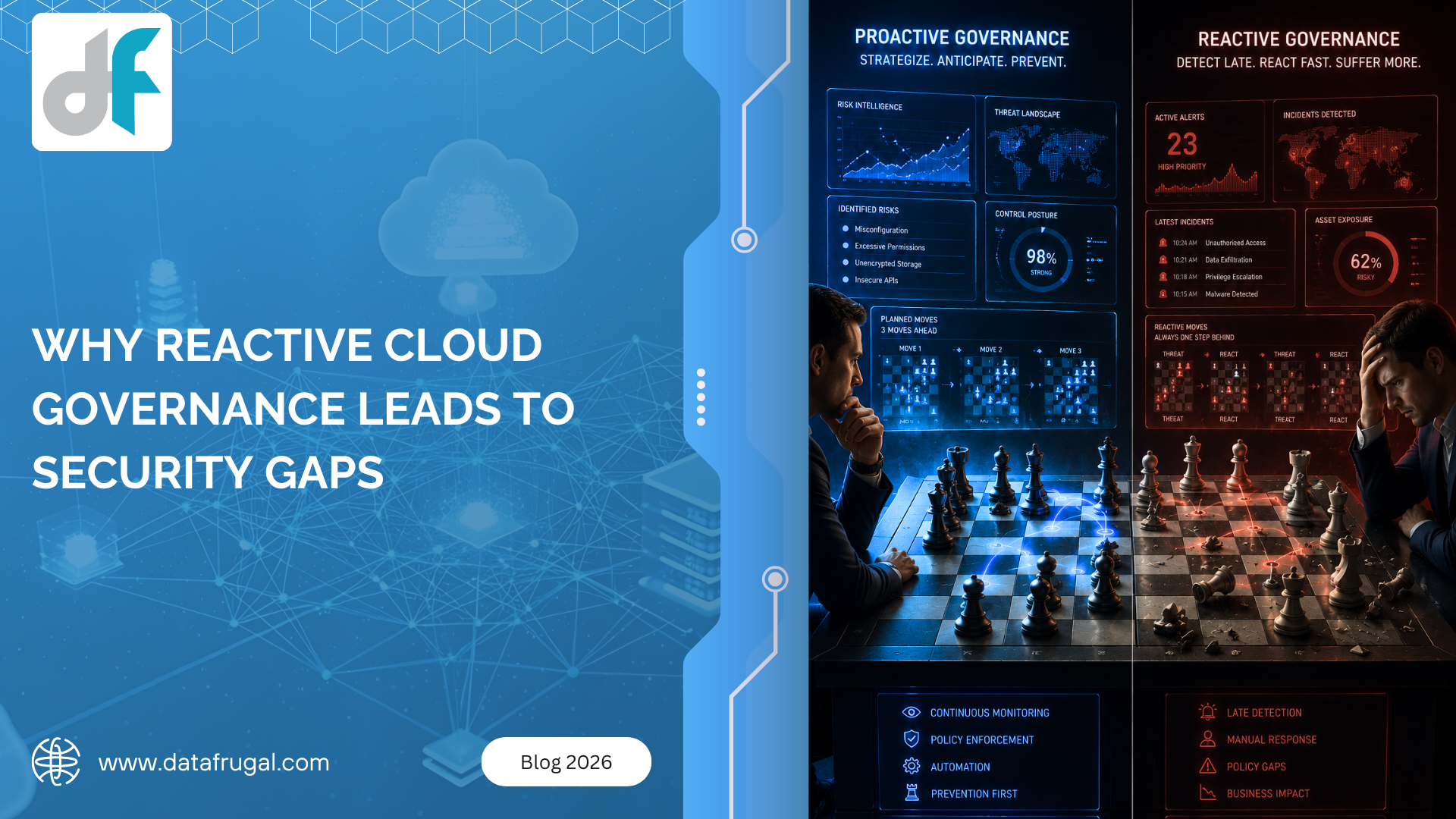
Most organizations do not invest in governance until something goes wrong.
A customer asks difficult security questions. An audit exposes missing evidence. A cloud storage environment is accidentally exposed. An employee makes a configuration mistake. An AI automation tool performs an unexpected action.
Only then does governance become a priority.
The problem is that by the time organizations start addressing governance gaps, the risks have often existed for months or years.
This is why proactive cloud governance is becoming increasingly important for cloud-native businesses. Strong governance is not about reacting to incidents. It is about preventing operational, security, and compliance issues before they become business problems.
Why Governance Is Often Treated as a Future Problem
In the early stages of growth, speed usually takes priority over governance.
Teams focus on:
- Product development
- Customer acquisition
- Infrastructure scaling
- Feature delivery
- Automation initiatives
Governance controls are often postponed because they do not appear to deliver immediate business value.
As a result, organizations gradually accumulate hidden risks such as:
- Shared administrative credentials
- Inconsistent access controls
- Missing audit visibility
- Publicly exposed storage
- Weak retention policies
- Untracked operational activity
- Excessive permissions granted to users or automation tools
These issues rarely create immediate failures. Instead, they quietly increase risk over time.
The Cost of Reactive Governance
Reactive governance begins after an incident, audit request, customer review, or security concern.
The organization is forced to answer questions such as:
- Who accessed the data?
- Can we prove what happened?
- Were retention policies followed?
- Which systems were affected?
- Is there an immutable record of activity?
Unfortunately, many organizations discover they cannot answer these questions confidently.
This creates operational challenges such as:
- Delayed incident investigations
- Increased audit preparation costs
- Customer trust concerns
- Compliance gaps
- Slower enterprise onboarding
- Internal confusion during recovery efforts
Governance becomes significantly more expensive when it is implemented under pressure.
How Security Gaps Develop in Cloud Environments
Security gaps rarely appear because organizations intentionally ignore security.
Most gaps emerge from operational growth.
As infrastructure expands, teams add:
- New cloud accounts
- Additional storage environments
- Third-party integrations
- Automation workflows
- AI-powered operational tools
- New employees and contractors
Without governance controls, visibility starts decreasing.
Over time, organizations lose clarity around:
- Who has access to critical data
- How data is being shared
- Whether retention policies are enforced
- What operational changes have occurred
- Which actions are traceable
This is where cloud risk management becomes critical.
The earlier organizations identify governance weaknesses, the easier they are to address.
Why AI Adoption Is Increasing Governance Risk
AI is accelerating operational efficiency across cloud environments.
Teams now use AI for:
- Infrastructure automation
- Code generation
- Operational workflows
- DevOps assistance
- System administration
While these tools improve productivity, they also introduce new governance challenges.
Questions organizations increasingly face include:
- Can AI systems modify production environments?
- Are actions traceable?
- Can destructive operations be audited?
- Are access boundaries properly enforced?
- Can recovery data be protected from automation mistakes?
Several high-profile incidents have demonstrated that automation and AI can perform unintended actions when governance controls are weak.
This is creating a growing demand for operational accountability and governance visibility.
What Proactive Cloud Governance Looks Like
Effective governance is not about slowing teams down.
It is about creating visibility, accountability, and operational confidence.
Organizations adopting proactive cloud governance typically focus on:
- Operational traceability
- Audit visibility
- Access governance
- Retention controls
- Immutable operational evidence
- Governance reporting
- Recovery governance
These controls help organizations identify risks before incidents occur.
More importantly, they help answer difficult questions when incidents do happen.
Why Enterprise Cloud Security Depends on Governance
Many organizations view security and governance as separate initiatives.
In reality, strong enterprise cloud security depends on governance foundations.
Security controls protect systems.
Governance helps prove those controls are working.
Without governance visibility, organizations often struggle to demonstrate:
- Operational accountability
- Access control enforcement
- Retention compliance
- Incident history
- Audit readiness
As enterprise customers become more security conscious, the ability to provide evidence is becoming just as important as the controls themselves.
How DataFrugal Supports Proactive Governance
DataFrugal helps organizations establish governance visibility before incidents, audits, or customer reviews expose operational gaps.
Instead of relying solely on provider-specific logs and monitoring tools, teams can create centralized operational traceability across cloud environments.
DataFrugal helps organizations:
- Improve audit visibility across object and storage operations
- Support governance reporting and evidence collection
- Improve operational traceability across environments
- Support immutable operational records
- Strengthen retention governance and accountability
- Improve visibility into access and operational activity
- Simplify governance reviews and customer audits
This helps organizations strengthen cloud risk management while building the operational trust required for long-term growth.
Summary
Reactive governance often begins after an incident, audit request, or customer review exposes visibility gaps. By then, governance becomes more expensive, disruptive, and difficult to implement.
Organizations that invest in proactive cloud governance early gain better operational visibility, stronger accountability, and improved resilience against security, compliance, and operational risks. Governance is most effective when it prevents problems, not when it is forced to explain them after the fact.
FAQs
Why do most organizations adopt governance only after an incident?
Governance often appears secondary to growth initiatives until a security incident, customer audit, or compliance review exposes visibility and accountability gaps.
How does cloud risk management help reduce security gaps?
Cloud risk management helps organizations identify operational weaknesses, access risks, governance gaps, and compliance concerns before they create larger business problems.
Why is operational traceability important during incidents?
Operational traceability helps teams understand what happened, who performed specific actions, when changes occurred, and how systems were affected.
How does AI increase governance requirements?
AI and automation tools can perform large-scale actions quickly. Without governance controls and audit visibility, organizations may struggle to monitor or verify those actions.
Why is governance becoming part of enterprise cloud security?
Enterprise customers increasingly expect evidence of operational accountability, retention controls, and access governance. Security controls alone are often no longer enough during reviews and audits.