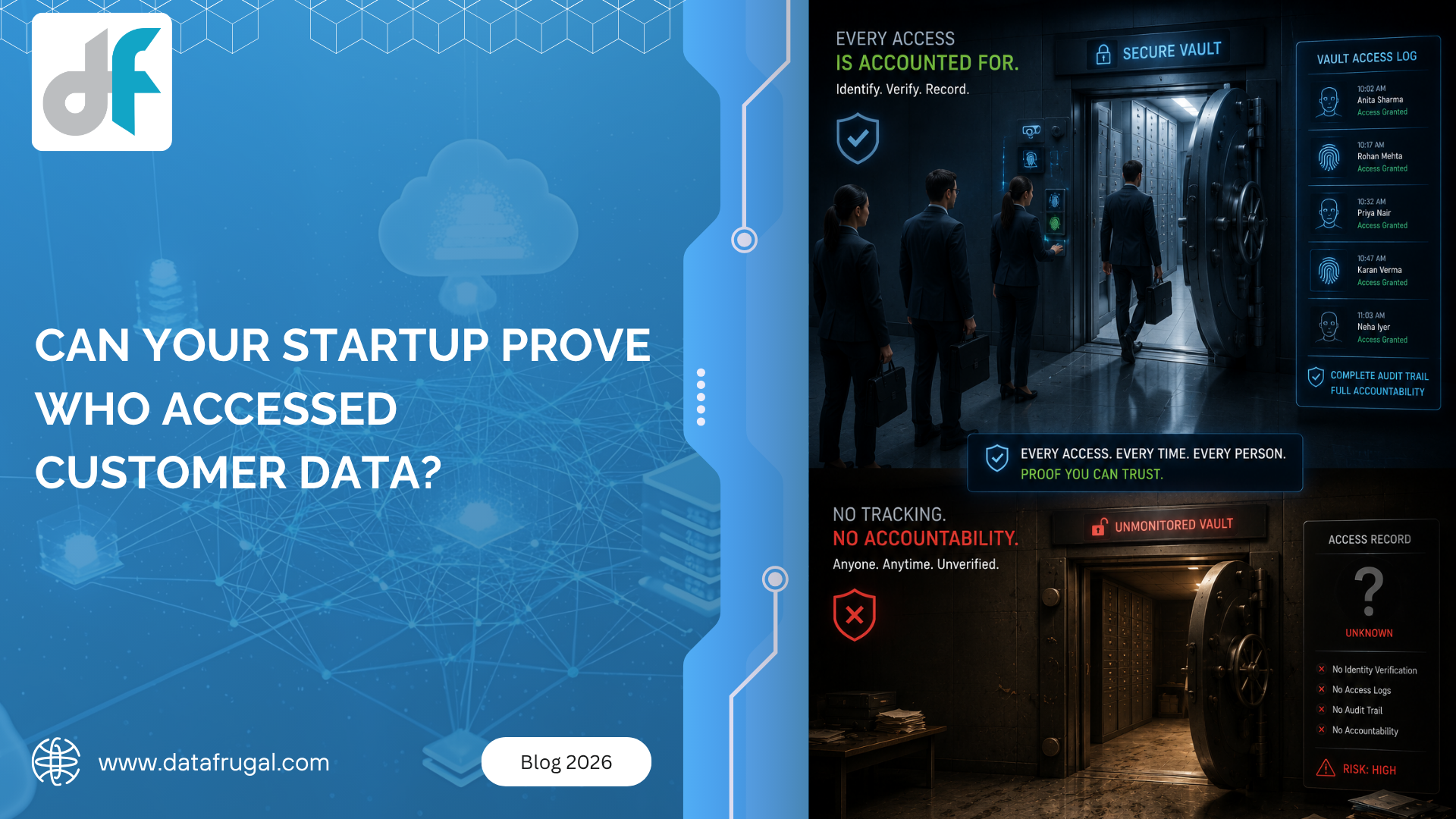
Imagine receiving an email from a large enterprise customer asking a simple question before signing the contract:
"Can you prove who accessed our data over the last six months?"
For many startups, the answer is uncomfortable.
The data may be secure. Access controls may exist. But proving exactly who viewed, downloaded, shared, or modified customer data is often much harder than expected.
This challenge usually doesn't appear during product development. It surfaces during enterprise onboarding, security questionnaires, investor due diligence, or after an unexpected incident.
Today's customers increasingly expect evidence, not assumptions. This is why data access governance is becoming a critical capability for growing cloud-native businesses.
Why Startups Rarely Think About Access Evidence Early
Startups naturally prioritize speed.
Engineering teams focus on shipping features, onboarding customers, and scaling infrastructure. Governance often feels like something to address later.
As the company grows:
- New developers join the team
- Contractors receive temporary access
- AI tools and automation are introduced
- Multiple cloud environments are created
- Customer data spreads across different storage systems
Initially, everything appears manageable.
Over time, answering basic governance questions becomes increasingly difficult.
Questions like:
- Who downloaded a customer's data?
- Was customer information shared outside the organization?
- Which administrator changed retention policies?
- Who accessed production objects during an incident?
Without structured governance, these answers often require manual investigation or may not be available at all.
Enterprise Customers Expect Operational Evidence
Security reviews have changed significantly over the last few years.
Enterprise customers no longer ask only whether encryption or access controls exist.
They increasingly ask organizations to prove:
- Who accessed customer information
- When access occurred
- Whether sensitive objects were downloaded
- How operational changes are tracked
- Whether governance controls are enforced
- Whether operational history can be verified
This is where audit evidence and governance visibility become essential. The ability to demonstrate operational accountability often becomes a competitive advantage during enterprise sales.
Monitoring Activity Is Different from Proving Accountability
Many startups believe they already have monitoring because cloud providers generate logs.
While monitoring is important, it is only part of the picture.
Infrastructure monitoring typically answers questions like:
- Is the application healthy?
- Are servers running?
- Did an API fail?
- Is storage available?
Governance requires a different level of visibility.
Organizations also need to know:
- Who performed the action
- Which object was accessed
- Whether data was downloaded or shared
- Whether policy changes occurred
- Whether the activity followed governance rules
This is where cloud activity monitoring becomes more valuable when combined with operational traceability and audit evidence.
Why Investigations Become Difficult Without Governance
Most organizations only recognize governance gaps after something unexpected happens.
Examples include:
- A customer reports suspicious activity
- A production incident affects sensitive data
- An employee accidentally exposes cloud storage
- AI or automation performs an unintended operation
- An audit requests historical evidence
During these situations, teams need immediate answers.
Without centralized governance visibility, investigations often involve searching across multiple cloud providers, different logging systems, and disconnected operational records.
This increases recovery time and reduces confidence in the investigation.
Governance Builds Customer Trust Before Problems Occur
Customers trust organizations that can demonstrate operational maturity.
Being able to show who accessed data, when it happened, and what actions were performed creates confidence long before an incident occurs.
Strong data access governance helps organizations:
- Demonstrate accountability during enterprise reviews
- Support customer security questionnaires
- Improve operational traceability
- Simplify audit preparation
- Reduce investigation time
- Build trust through verifiable evidence instead of manual explanations
Governance is no longer just about compliance. It has become part of the customer experience.
How DataFrugal Helps Startups Prove Data Access Activity
DataFrugal helps startups establish governance visibility without introducing enterprise-level complexity.
Instead of relying only on provider-specific logs, organizations gain centralized operational traceability across cloud storage environments.
DataFrugal helps organizations:
- Monitor object-level uploads, downloads, and sharing activity
- Collect immutable operational evidence for customer reviews, audit certifications, and investigations
- Improve visibility into who accessed critical customer data
- Support governance reporting and audit readiness
- Apply retention controls for operational records
- Improve accountability across cloud environments
- Simplify investigations using centralized governance visibility
This helps startups strengthen data access governance while building the operational trust enterprise customers increasingly expect.
Summary
As startups grow, proving who accessed customer data becomes just as important as protecting it. Enterprise customers, investors, and auditors increasingly expect organizations to provide evidence of operational accountability rather than relying on trust alone.
By combining cloud audit logs, cloud activity monitoring, and structured governance practices, startups can strengthen customer confidence, simplify investigations, and prepare for enterprise growth without waiting for an incident to expose governance gaps.
Frequently Asked Questions (FAQs)
Why do enterprise customers ask for data access evidence?
Enterprise customers need confidence that sensitive information is being managed responsibly. Evidence of access activity helps them evaluate operational maturity and governance practices before sharing business-critical data.
What information should cloud audit logs capture?
Cloud audit logs should record who accessed data, when the activity occurred, what actions were performed, whether data was shared or downloaded, and any changes made to governance policies or retention settings.
Why isn't cloud activity monitoring enough on its own?
Cloud activity monitoring helps detect operational events, but governance requires evidence that can explain who performed an action, why it happened, and whether it complied with organizational policies.
How can startups prepare for enterprise security reviews?
Building governance visibility early helps startups answer customer security questionnaires, provide operational evidence, and avoid delays during enterprise onboarding or compliance reviews.
What happens when a startup cannot prove who accessed customer data?
Lack of operational evidence can delay enterprise deals, increase investigation time after incidents, reduce customer confidence, and create challenges during audits or investor due diligence.