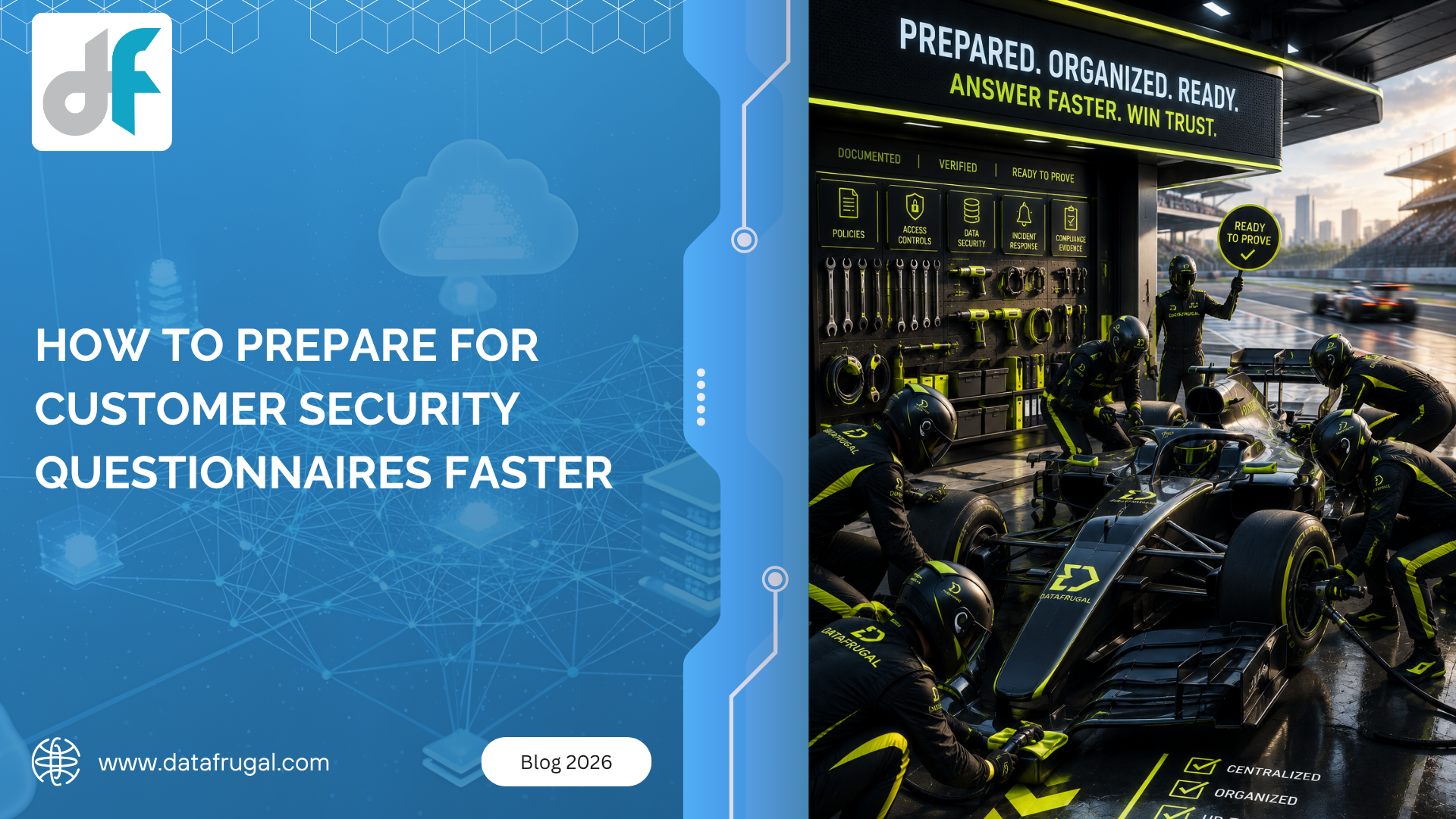
For many startups and growing SaaS companies, the biggest obstacle to winning an enterprise customer is not the product. It is the security questionnaire.
Questions like:
- Can you prove who accessed our data?
- How do you enforce data retention?
- Can you demonstrate audit evidence?
- How do you prevent unauthorized deletion?
- What governance controls do you have in place?
These questionnaires are no longer simple checklists. They are used by enterprise customers to evaluate operational maturity, governance practices, and long-term business risk.
Many companies only begin preparing after receiving the questionnaire. By then, gathering evidence becomes a time-consuming process involving engineering, DevOps, and security teams.
The organizations that respond quickly are usually not the ones with the largest security teams. They are the ones that have already built governance into their operations.
This is why security compliance automation is becoming an important part of enterprise readiness.
Why Customer Security Questionnaires Delay Enterprise Sales
Security reviews often become the longest stage of the sales process.
The challenge is rarely answering the questions. It is proving the answers.
Many organizations know they have security controls but struggle to provide supporting evidence.
Common problems include:
- Audit evidence spread across multiple cloud platforms
- Manual collection of screenshots and logs
- Difficulty proving who accessed customer data
- Unclear retention and governance policies
- Different teams owning different parts of the evidence
- Last-minute requests creating pressure on engineering teams
When evidence is difficult to gather, sales cycles become longer and customer confidence decreases.
Why Governance Matters More Than Documentation
Many organizations try to prepare for customer questionnaires by creating documents.
Documentation is useful, but enterprise customers increasingly want operational evidence instead of written statements.
They want proof that governance controls are actually working.
Typical questions include:
- Can you demonstrate access history?
- Can you show immutable operational records?
- Can you prove retention policies are enforced?
- Can you verify administrative actions?
- Can you provide audit history for customer data?
These questions cannot be answered with documentation alone.
They require operational visibility.
This is where cloud governance becomes essential.
Build Evidence Before Customers Ask for It
Organizations rarely know exactly when the next enterprise opportunity will arrive.
Instead of collecting evidence after receiving a questionnaire, leading teams continuously build governance evidence as part of daily operations.
This approach provides several advantages:
- Faster responses to customer reviews
- Reduced engineering effort
- Better operational accountability
- Improved audit visibility
- Greater customer confidence
- Less disruption during enterprise onboarding
Governance should become part of the operational workflow rather than a project completed before every customer review.
Why Security Compliance Automation Saves Time
Manual evidence collection does not scale.
As organizations grow, cloud environments become larger, more distributed, and increasingly automated.
This makes manual governance reporting difficult.
Security compliance automation helps organizations continuously collect operational evidence instead of recreating it during every customer review.
This helps teams:
- Reduce manual documentation effort
- Improve governance consistency
- Simplify evidence collection
- Respond faster to customer questionnaires
- Support future compliance initiatives
- Reduce operational overhead
Automation allows engineering teams to stay focused on product development instead of repeatedly gathering the same information.
Audit Readiness Should Be Continuous, Not Event Driven
Many businesses prepare for audits only after a customer requests evidence.
The same pattern happens before:
- ISO certification
- SOC reviews
- Investor due diligence
- Enterprise onboarding
- Compliance assessments
This reactive approach often creates unnecessary pressure across engineering and security teams.
Strong audit readiness means organizations already know:
- Who accessed critical data
- What operational changes occurred
- Whether governance controls were followed
- Which retention policies are active
- Where operational evidence is stored
When governance is built into everyday operations, customer reviews become much easier to manage.
How DataFrugal Helps Organizations Respond Faster
DataFrugal helps organizations establish governance visibility before customer questionnaires arrive.
Instead of collecting operational evidence manually from multiple systems, teams can maintain centralized governance records that support customer reviews and audit preparation.
DataFrugal helps organizations:
- Improve audit visibility across storage and object operations
- Collect operational evidence continuously instead of manually
- Monitor object-level access and administrative activity
- Support immutable operational records for governance reviews
- Improve retention governance and operational accountability
- Simplify customer security reviews and enterprise onboarding
- Reduce engineering effort during audit preparation
This helps organizations strengthen cloud governance while improving audit readiness and reducing the time required to respond to enterprise security questionnaires.
Summary
Customer security questionnaires are becoming a standard part of enterprise sales. The organizations that respond quickly are usually those that have already built governance, operational visibility, and evidence collection into their cloud environments.
By adopting security compliance automation and maintaining continuous audit readiness, businesses can shorten sales cycles, reduce engineering effort, and build greater trust with enterprise customers.
Frequently Asked Questions (FAQs)
Why do enterprise customers send security questionnaires?
Enterprise customers use security questionnaires to evaluate how vendors protect customer data, manage operational risks, and demonstrate governance before sharing sensitive information or signing long-term contracts.
Why do security questionnaires take so long to complete?
The biggest delay is usually gathering evidence. Many organizations have security controls in place but struggle to prove them because operational information is spread across different systems and teams.
How does security compliance automation improve questionnaire responses?
It continuously collects governance evidence during normal operations, allowing teams to respond with documented proof instead of manually assembling information for every customer request.
What information should organizations have ready before a customer review?
Organizations should be able to demonstrate access history, retention controls, operational accountability, immutable records, and governance activity across their cloud environments.
Why is audit readiness important even before compliance certifications?
Enterprise customers and investors often request operational evidence before formal certifications are required. Being audit ready helps organizations respond confidently, reduce delays, and strengthen customer trust.